CRASH PROOF
TRAINING
© 2025 Driving Hero Academy. All rights reserved.
Start Here | About | Programs | Articles | Contact
Speed Doesn't Kill... Impact Does
We need to change how we talk about speed and
safety. The familiar warning "Speed Kills" is both
technically wrong and practically ineffective, and
drivers know it. I drove 110 km/h (68 mph) just the
other day and lived to tell the tale.
When drivers regularly travel at 110, 120, even 140
km/h (68, 75, 87 mph) without incident, they learn
to dismiss safety messages that don't match their
lived experience.
The truth is more nuanced and more important:
speed doesn't kill, but impact does. And the real
danger isn't speed itself. It's primarily the lethal
combination of speed and insufficient eye lead
(how far ahead the driver is looking) time that
leaves drivers unable to stop before impact.
The Invisible Two-Thirds of Stopping
Ask most drivers how long it takes them to stop, and they'll vastly underestimate the distance. That's because
stopping actually happens in three distinct stages, but our brains are oblivious to the first two stages:
1.
Perception Time (0.75 seconds): The time it takes to recognize there's a problem. Something enters your field of
vision and your brain must process what it's seeing and identify it as a hazard requiring action.
2.
Reaction Time (0.75 seconds): The time it takes to get your foot from the gas to the brake. The car is still travelling
at full speed. (The faster you are moving, the further the distances are that you will travel in that 1.5 seconds).
3.
Braking Distance: Finally, the moment your foot hits the brake until the vehicle stops.
During those first 1.5 seconds of perception and reaction time, a vehicle at 110 km/h (68 mph) travels approximately
46 meters (150 feet) before the brakes even begin to engage. At 70 km/h (43 mph), that's still 29 meters (95 feet).
The distance travelled during perception and reaction are invisible distances to most drivers, who believe they can
stop within whatever space it takes, once they press the brake pedal.
This fundamental misunderstanding of stopping distance is rarely, if ever, made clear to new drivers. Most driving
instructors do not understand this well (it's not required knowledge for typical driving instructor training/testing). We
are certainly not making sure our new drivers understand it before we hand them their licenses. And because the
ability to maintain proper eye lead time at any given speed isn't on road tests, the vast majority of driving schools
don't teach it in a meaningful way. It is any wonder that so many new drivers die, driving really fast?
Looking Ahead: The Critical Skill We Don't Teach
The distance you need to be looking ahead isn't arbitrary. It must accommodate the complete stopping sequence at
your current speed. That means scanning far enough ahead to account for 0.75 seconds of perception time, 0.75
seconds of reaction time, plus the full braking distance.
Most drivers aren't looking far enough ahead
consistently for 70 km/h (43 mph), let alone 110 km/h (68 mph). Often, drivers believe the most important thing is just
keeping the car between the lines and you don’t have to look very far ahead to do that.
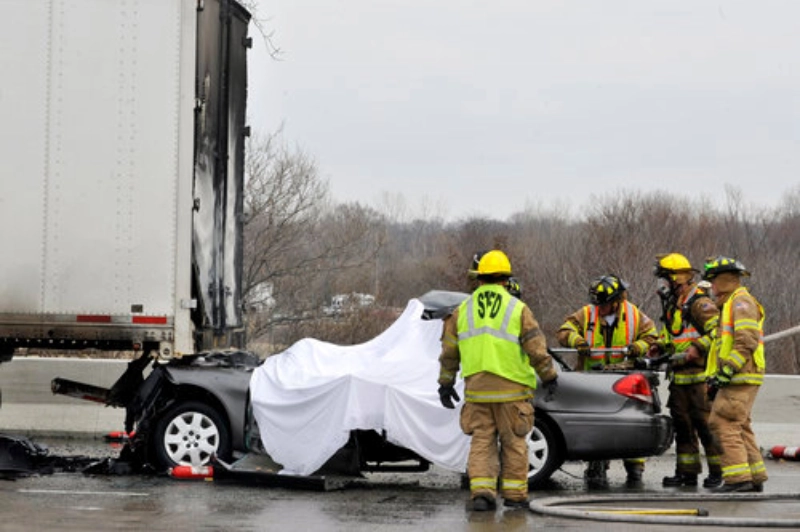
This is why the horrific crashes we see at higher speeds tend to follow the same pattern: by the time the driver finally
sees the problem (a stopped vehicle, a pedestrian, an obstacle in the road), it's already too late. They were travelling
faster than their eye lead time could support.
When Keeping It Between
the Lines Kills
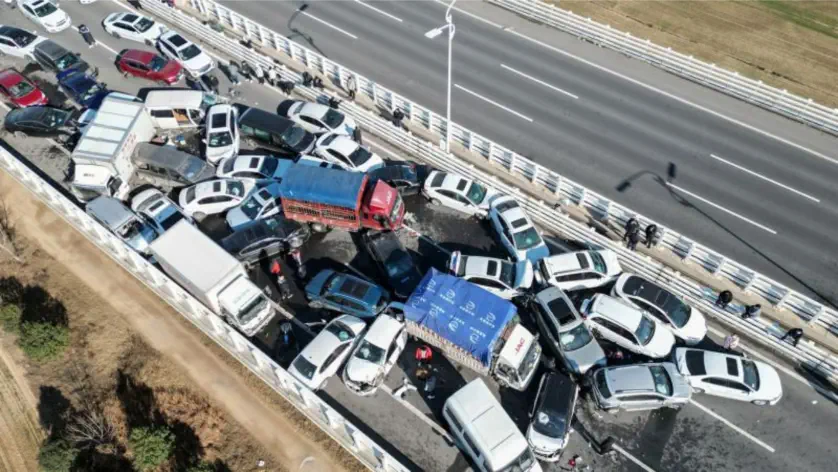
This same fatal assumption
causes every single pileup on
icy highways and in foggy
conditions. Drivers assume
nothing bad will happen if they
just keep it between the lines.
But visibility and road
conditions don't care about
lane markers.
Consider a driver in dense fog
on a highway. Visibility has
been reduced so much that
they can just make out the
lines of the highway directly in
front of their car. They might slow down a bit, perhaps from 110 km/h to 80 km/h (68 mph to 50 mph), or maybe to 70
or even 60 km/h (43 or 37 mph), thinking they're being cautious. But at 70 km/h, that driver will travel 29 meters (95
feet) during just the perception and reaction time, before their foot even touches the brake. Add in actual braking
distance, and they need roughly 70 meters (230 feet) of clear road ahead to stop. At 80 km/h (50 mph), those
numbers climb even higher.
If you can only see the lines on the road directly in front of your car, perhaps 10 or 20 meters ahead, your brain won't
even make it through perception time before impact. There will be no slowing down before the crash. The driver's foot
won't even reach the brake pedal.
On icy highways, the problem multiplies. A driver sees tail lights materialize in the fog ahead, or spots a stopped
vehicle. By the time their brain registers the hazard, their 1.5 seconds of perception and reaction time have already
closed most or all of the gap. Then, when the brakes finally engage on ice, the stopping distance can be two to ten
times longer than on dry pavement. Another car joins the pileup. Then another. And another.
These aren't "accidents." They're predictable outcomes of driving faster than your eye lead time and road conditions
allow.
The Mathematics of Impact
Here's where speed becomes deadly. Every time you double your speed, you quadruple the force of impact. This is
basic physics: kinetic energy increases with the square of velocity.
A crash at 100 km/h (62 mph) doesn't deliver twice the impact force of a crash at 50 km/h (31 mph). It delivers four
times the force. At 140 km/h (87 mph) versus 70 km/h (43 mph), you're looking at four times the destructive energy.
These are forces the human body simply cannot withstand.
So while speed itself doesn't kill, the impact generated by speed absolutely does. And that impact becomes inevitable
when drivers combine speed with inadequate eye lead time.
The Real Safety Message
We need to stop telling drivers that "speed kills" and start teaching them something more useful and more honest:
You must always be able to stop within the distance you can see, including the invisible perception and reaction time.
This principle applies at any speed, in any conditions. Whether you're driving at night, in a blizzard, in dense fog, or on
a sun-drenched highway, the rule is the same. If your eye lead time doesn't extend far enough to allow you to
perceive a hazard, react to it, and bring your vehicle to a complete stop before reaching it, you're driving too fast for
conditions, even if you're under the speed limit.
The speed limit tells you the maximum legal speed. Your eye lead time and visibility tell you the maximum safe speed.
They're not always the same number.
Until we make this fundamental understanding part of driver education and testing, until we teach new drivers to
constantly calibrate their speed to their visual scanning distance, we'll continue to see the same preventable tragedies
play out on our roads. Not because speed kills, but because inadequate eye lead time combined with speed
guarantees a deadly impact.